
On this page
Where half-round suits Durham houses
Durham's older neighborhoods are full of houses that look right with half-round gutters:
- Queen Anne houses of the 1880s to 1910s in Cleveland-Holloway, Old North Durham and Morehead Hill
- Craftsman bungalows across Trinity Park, Duke Park and Watts-Hillandale
- Colonial and Tudor Revival homes of the 1920s to 1950s in Forest Hills and Hope Valley
The Trinity Historic District alone counts 751 contributing buildings, mostly houses, built from the 1890s to 1960, with Queen Anne and bungalow styles the most notable.
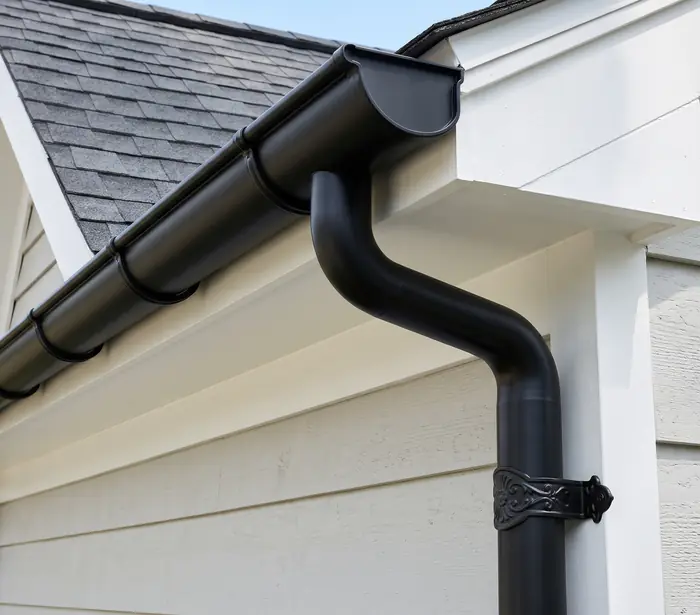
Half-round vs K-style
| Half-round | K-style | |
|---|---|---|
| Look | Rounded, traditional | Flat front with a decorative profile |
| Capacity | Less for the same width | More for the same width |
| Downspout | Round | Rectangular |
| Hanging | Brackets or hook hangers | Hidden hangers inside the trough |
| Typical use | Older and historic homes | Most houses built since the 1960s |
| Cost | Usually more | Usually less |
Sizing half-round for summer storms
Because a half-round carries less than a K-style of the same width, it pays to size up. Durham's summer months bring about 5 inches of rain each, much of it in short storms, and a 5-inch half-round on a steep bungalow roof can overflow. A 6-inch half-round with 3- or 4-inch round downspouts is common.
Materials
| Material | Notes |
|---|---|
| Painted aluminum | Most affordable, light on old fascia, many colors |
| Galvalume or galvanized steel | Stiffer, can be painted; watch for rust at scratches |
| Copper | Traditional, lasts decades, patinas to brown then green; about $30 to $50 a foot |
See copper gutters.
Hanging on old houses
Many older Durham houses have deep, decorative cornices, exposed rafter tails on bungalows, or fascia that has been patched for a century. Half-round brackets can be fastened to the fascia, to the face of rafter tails, or to the roof deck under the first shingle course. A contractor should look at what is there and propose a hanger that does not damage original trim.
Historic districts
Durham has several local historic districts as well as many National Register districts. If you are in a local district, exterior changes may need review. Switching from a missing or failed original gutter to a matching half-round is usually straightforward; switching to something very different may not be. Ask the city's preservation staff first.
What to ask
- What size half-round, and what downspout size?
- What material and color?
- How will the brackets be fastened without damaging trim?
- Seamless or sectional, and how are joints sealed?
Half-round sizes and downspouts
| Half-round size | Round downspout | Suits |
|---|---|---|
| 5-inch | 3-inch | Small porches, short bungalow eaves |
| 6-inch | 3- or 4-inch | Most bungalows and Queen Anne houses |
| 7- or 8-inch | 4-inch or larger | Large period houses, churches |
Hangers and brackets
Half-round is usually hung one of three ways: on brackets screwed to the fascia face, on shank hangers fastened to the roof deck under the first shingle course, or on brackets fixed to exposed rafter tails. Each suits a different house. On a bungalow with rafter tails and no fascia board, the rafter-tail bracket is often the only option. On a house with a new roof, fascia brackets avoid disturbing the shingles.
What to ask
- Which hanging method suits my house, and why?
- Will brackets be spaced closely enough for leaf and ice loads?
- What color and material, and will downspouts match?
- How will the gutter tie into any existing built-in gutter or cornice?
The cost of waiting
On older houses, failing gutters do their damage slowly: a little water behind the gutter every rain, a little more rot in the fascia and the trim each year. Because the trim on period houses is often original and hard to replace exactly, catching a leak early saves money and history.
Questions to ask about historic houses
- Have you worked on houses in Durham's historic districts?
- Can you match the existing gutter profile and downspout shape?
- How will you fasten brackets without splitting trim?
- Will you photograph anything unusual you find at the roof edge?