
On this page
Where copper fits in Durham
Copper suits the houses that already have the most character: the Queen Anne and Revival homes of Morehead Hill, the bungalows of Trinity Park, the large period houses of Forest Hills and Hope Valley, and new high-end homes in Treyburn. It is also common on churches and older institutional buildings.
Copper compared
| Copper | Aluminum | Steel | |
|---|---|---|---|
| Installed price per foot | about $30 to $50 | about $9 to $13 | about $8 to $20 |
| Life | Many decades | 20 years or more | Shorter once scratched |
| Joints | Soldered | Sealed | Sealed or soldered |
| Look | Bright, then brown, then green | Painted color | Painted or galvanized |
| Weight | Moderate | Light | Heavy |
How copper is installed
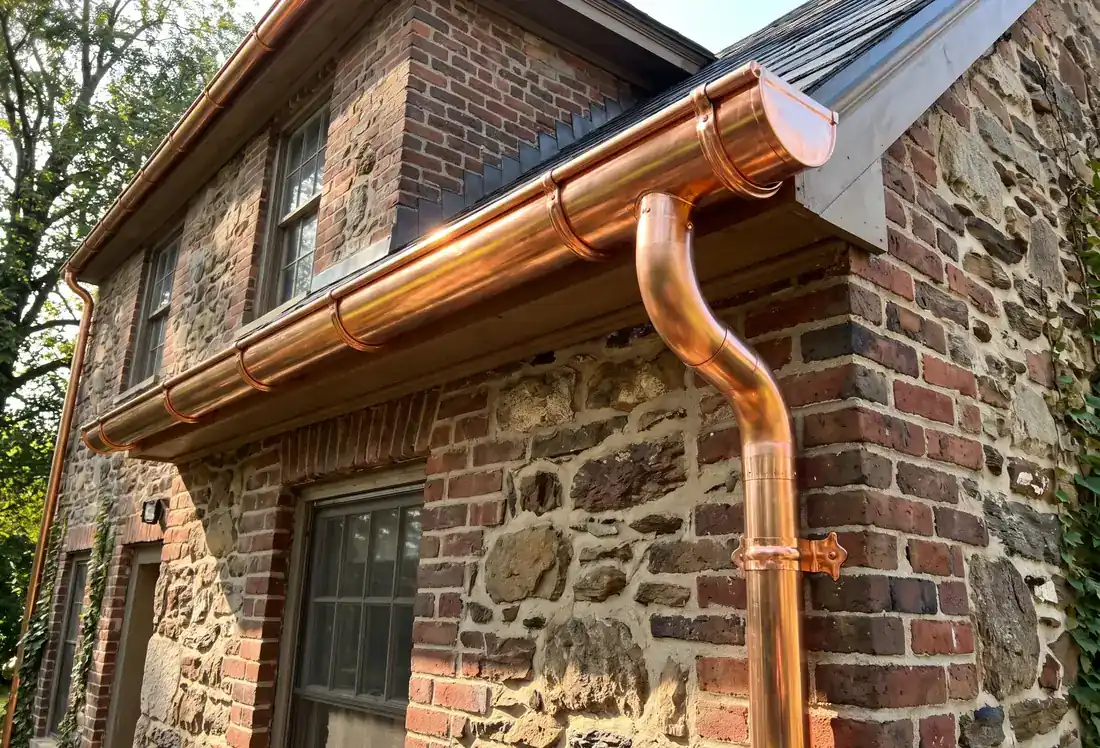
Copper is usually 16-ounce or 20-ounce sheet, formed into half-round or K-style. Joints are lapped and soldered rather than caulked, so a well-made copper system has no sealant to fail. Hangers, brackets, straps and fasteners are copper or a compatible metal. Downspouts are round or rectangular copper, sometimes with decorative conductor heads.
Installing copper is a skilled job. Ask to see photos of past copper work, and ask how joints will be soldered.
Mixing metals
Copper and aluminum do not mix. Where they touch, or where water runs off copper onto aluminum or galvanized steel, the other metal corrodes. If you are adding copper to part of a house, make sure flashing, drip edge and fasteners are compatible. Some moss and algae treatments for roofs are also corrosive to copper; ask before using them.
Copper, oaks and pines
Copper does not rust, and its stiffness helps against small limb impacts. Under Durham's aging street oaks and pines, though, a heavy limb will dent copper like anything else, and a dented copper section costs more to replace. Guards on copper should be copper or stainless, not aluminum.
Historic districts
On a house in a local historic district, copper half-round is often the most appropriate replacement for a failed original gutter. Ask the city's preservation staff before work starts if you are changing the style.
What to ask
- What weight of copper, and what profile?
- Will joints be soldered?
- Are all fasteners, brackets and straps copper or compatible?
- Where will downspouts discharge, and will runoff stain stone or concrete?
- Can I see photos of your past copper work?
What copper looks like over time
| Age | Color |
|---|---|
| New | Bright, shiny copper |
| Months | Darkens to brown |
| Years | Deep brown, then streaks of green in wet spots |
| Decades | Even green patina in many settings |
Some owners have new copper treated to slow the change; others prefer to let it weather.
Copper downspouts, heads and straps
A full copper system usually includes round or rectangular copper downspouts, copper straps, and sometimes decorative conductor heads at the top of the downspout. Every part that touches the copper should be copper or compatible, including fasteners and the drip edge behind the gutter. Mixing in aluminum or galvanized steel parts will corrode them.
Where water from copper lands
Runoff carries tiny amounts of copper, which can stain light stone, concrete and paint blue-green. Plan downspout discharge onto lawn, gravel or a splash block you do not mind staining, not onto a pale limestone step.
Where copper suits in the Triangle
| Area | Houses |
|---|---|
| Morehead Hill | Architect-designed houses of the 1910s to 1930 |
| Forest Hills, Hope Valley | Large period revival homes |
| Cleveland-Holloway | Queen Anne and Eastlake houses |
| Hillsborough | 18th and 19th century houses in the historic district |
| Chapel Hill | Historic houses near campus and in Gimghoul |
| Treyburn | High-end new homes |