
On this page
The short answer
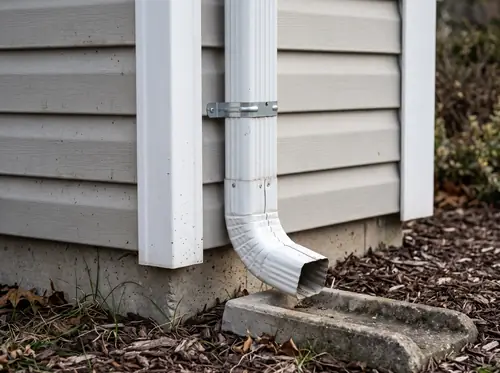
Get roof water at least several feet from the house, and further where the yard allows, and make sure it runs downhill. Durham County's rain garden manual uses 10 feet, downslope, as the minimum for soaking areas near foundations with a crawl space or basement. On red clay, water left at the foundation stays there.
Why clay changes things
Clay soils take water slowly. Rain that soaks into sandy soil in minutes can sit on clay for hours. The North Carolina Geological Survey identifies the Triassic basins and the Carolina terrane as parts of the state with more expansive, shrink-swell clay, and both run through the Durham area. Clay that swells when wet and shrinks when dry can move a foundation unevenly, especially when one corner gets all the roof water from a downspout and the rest of the house stays dry.
What water at the foundation does
| Effect | Why it matters |
|---|---|
| Damp crawl space | Raises moisture in floor framing; mold and rot |
| Soil movement | Cracks in brick, sticking doors, uneven floors over time |
| Termites | NC lists grading water away among fixes for termite-friendly moisture |
| Washouts | Mulch and soil carried off; exposed footings |
| Basement seepage | Water through walls and joints |
Options for getting water away
| Option | Distance | Best where | Watch out for |
|---|---|---|---|
| Splash block | 1 to 2 feet | Ground already slopes away | Sinks and turns over time |
| Rigid extension | 4 to 10 feet | Most yards | Mower damage, trip hazard |
| Flip-up extension | 4 to 6 feet | Beside walks and beds | Must be put down before rain |
| Buried solid pipe | To yard, swale or curb | Tight lots, patios | Needs slope; test old lines |
| Rain garden | 10+ feet, downslope | Yards with room | Size to the roof; keep 25 ft from septic |
| Rain barrel | At the downspout | Gardens | Needs overflow routed away |
How far is far enough
There is no single Durham rule for downspout distance on an existing house. Local rain garden guidance gives useful numbers:
- Durham County Soil and Water: rain gardens at least 10 feet away and downslope of a foundation with a crawl space or basement, 25 feet from a septic drain field, sized at about 10 percent of the area draining to them.
- Town of Chapel Hill: at least 10 feet from the foundation, 25 feet from a septic field or well head, and call 811 before digging.
Use those as a guide for where concentrated roof water should end up.
Grading
Even a long extension fails if the ground slopes back toward the house. The soil next to the foundation should fall away from it. If beds have been built up against the wall over the years, the slope may now run the wrong way.
Checklist
- Walk the house in a hard rain and watch where each downspout's water goes
- Note any pooling that lasts after the rain stops
- Check the crawl space for damp after storms
- Test buried lines with a hose
- Check that soil and mulch slope away from the wall
- Keep water off walks and driveways where it can freeze
See downspouts, downspout repair and Durham stormwater rules.
Signs water is getting to the foundation
| Sign | Where to look |
|---|---|
| Damp or musty crawl space | Crawl space door or vents after rain |
| Efflorescence (white crust) on brick or block | Foundation walls |
| Cracks in brick, stuck doors | Inside and out |
| Washouts along the drip line | Beds under the eaves |
| Mud tubes on the foundation | Possible termites; call pest control |
Common mistakes
- Building beds up against the wall, so the soil slopes toward the house.
- Short extensions that end in a flat bed beside the foundation.
- Burying corrugated pipe without slope, so it holds water and silt.
- Pointing downspouts at the neighbor.
When to call someone else
If the crawl space floods in every storm, or the foundation is cracking, gutters may only be part of the answer. A drainage contractor or structural engineer can assess grading, drains and the foundation itself. Gutter and downspout work is usually the cheapest first step.
Crawl spaces, slabs and basements
| Foundation | What wet soil does | Downspout priority |
|---|---|---|
| Crawl space | Raises humidity under the floor; wet sills and joists | Very high; most Durham houses |
| Slab | Can move with clay; water at slab edges | High |
| Basement | Seepage through walls and joints | Very high |
Most older and many newer Durham houses sit on crawl spaces. Durham County's rain garden manual treats crawl spaces and basements the same way: soaking areas at least 10 feet away and downslope. On a slab, the manual allows downslope placement without the same distance.
Neighborhood notes
- Creek-side lots in Northgate Park and near the Eno in north Durham already stay wet; carry roof water to the street side.
- Hillside houses in Morehead Hill, Hope Valley and Chapel Hill need uphill downspouts carried around the house.
- New subdivisions near Southpoint and in Morrisville have thin topsoil over graded clay; follow the builder's grading away from the house.
- Rural lots in Bahama and Rougemont need water kept off septic fields as well.
Questions to ask a contractor
- Where will each downspout discharge?
- How far from the foundation, and is that downhill?
- Will you test my buried lines?
- What happens to the water in a really big storm?