
On this page
Common downspout problems
| Problem | Sign | Fix |
|---|---|---|
| Clogged elbow | Gutter overflows above the downspout; downspout is quiet in rain | Clear or replace elbows |
| Loose straps | Downspout leans or rattles | New straps into solid wood or masonry |
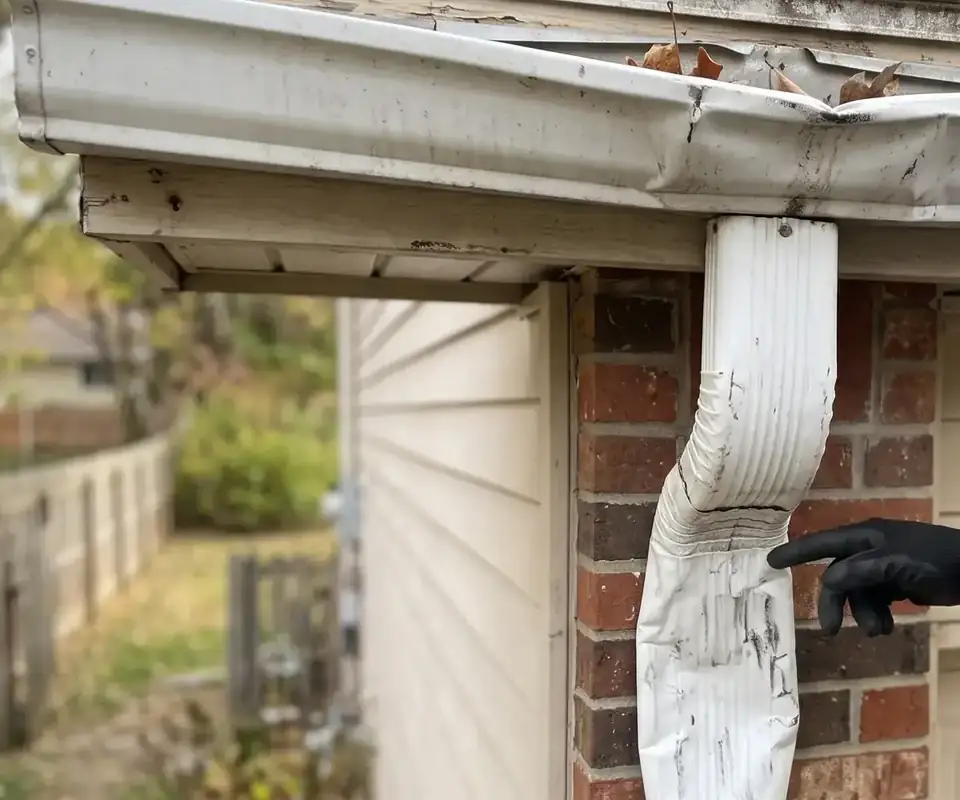
| Crushed section | Dented bottom section, water bursting out | Replace section |
| Disconnected joint | Water sprays from a joint | Re-seat and fasten |
| No extension | Pool or washout at the base | Add extension |
| Sunk splash block | Water runs back to the wall | Reset or replace |
| Blocked buried line | Downspout backs up and overflows at the ground joint | Clear or replace the line |
Why pooling matters in Durham
Pooling water is not just untidy. Durham County sits on rocks that the North Carolina Geological Survey identifies as having more shrink-swell clay. Clay that is wet beside the foundation and dry elsewhere moves unevenly. A crawl space that stays damp from downspout water raises the moisture in the framing, and the state's pest control division lists gutters and grading water away among the ways to cut moisture that attracts subterranean termites.
Clogs from Durham's trees
Loblolly needles are 6 to 9 inches long and tend to lodge across the outlet and pack into the bottom elbow. Sweetgum balls roll into outlets and jam. Willow oak leaves mat. A 3x4 downspout clogs far less than a 2x3, and fewer, gentler elbows help.
Where the water should go
- Extensions several feet long, ideally to ground that slopes away.
- Buried lines of solid pipe to the yard, a swale or the curb, sloped all the way.
- Rain gardens placed by Durham County's rain garden manual at least 10 feet away and downslope of a foundation with a crawl space or basement.
- Not toward a neighbor, a walk, a driveway or a doorway.
Buried lines
Many older Durham houses have downspouts running underground into clay tile or corrugated pipe. Over decades they crack, crush and fill with roots. When the line blocks, water backs up the downspout and overflows at the ground joint, right at the foundation. Test with a hose. If the line cannot be cleared, it can be replaced with solid pipe, or abandoned in favor of an extension.
How it is fixed
- Find where the water is going wrong: top, joints, bottom or underground.
- Clear clogs and test with a hose.
- Replace crushed sections and elbows.
- Fit new straps into sound wood or masonry.
- Add or extend extensions, or reroute the downspout.
- Test the buried line, and clear or replace it if needed.
Cost factors
Most downspout repairs are small jobs. Rerouting downspouts, adding new ones or replacing buried lines costs more, depending on length and what is in the way. Ask for each part to be priced.
Testing a buried line
- Disconnect the downspout at ground level.
- Run a hose into the pipe at a steady flow.
- Find the outlet and watch for water.
- If nothing appears, or it backs up at the inlet, the line is blocked or broken.
- A plumber's camera or jetter can find and clear the blockage; a collapsed line needs replacing.
Where buried lines usually go wrong
| Problem | Cause |
|---|---|
| Roots | Trees find the moisture and grow into joints |
| Silt and debris | Needles and grit washed down the downspout |
| Crushed pipe | Vehicles, settling, thin corrugated pipe |
| Outlet buried | Lawn or mulch built up over the end |
| No slope | Pipe laid flat or sagging |
Durham's clay
Clay is slow to take water, so a line that once drained into a pocket of gravel may now just hold water. The North Carolina Geological Survey lists the rock belts under Durham County among those with more shrink-swell clay, which can also shift and crack old pipe. Lines that end above ground, at a pop-up emitter or open outlet, are easier to check and keep working.
The cost of waiting
A blocked downspout turns the gutter above it into an overflow channel, dumping a roof's worth of water at the foundation in every rain. On clay, that water sits. Over a season it can soak the crawl space, wash out beds and stain siding. Clearing a downspout or adding an extension is a quick fix by comparison.
Neighborhood notes
Older houses in Northgate Park, Duke Park and Parkwood often have buried lines from decades ago. Houses under pines in Woodcroft and Treyburn clog 2x3 downspouts every fall. Newer houses near Southpoint often have downspouts discharging onto driveways and walks.