
On this page
Why gutters sag
| Cause | How to tell | Fix |
|---|---|---|
| Spikes worked loose | Spike heads stick out from the gutter face | Replace with hidden hangers |
| Hangers too far apart | Dips between hangers | Add hangers at close spacing |
| Weight of debris | Gutter full of wet needles and leaves | Clean, then rehang |
| Soft fascia | Screws spin; wood is dark or crumbly | Replace fascia, then rehang |
| Ladder or limb damage | Bent section, kinked hangers | Replace hangers or section |
| Lost pitch | Water stands after rain | Reset pitch |
Spikes and ferrules
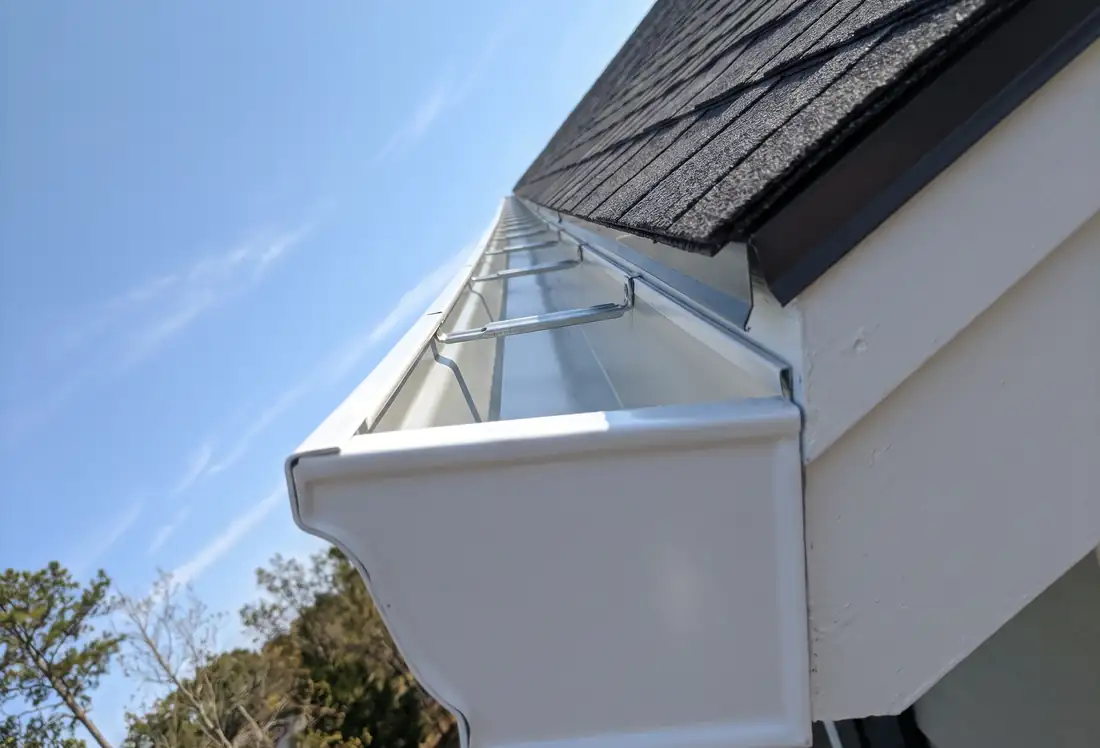
Many older Durham houses, and some built through the 1990s, have gutters held on with long spikes driven through the gutter and a ferrule sleeve into the fascia. Every summer and winter the gutter expands and contracts, and the spikes work loose. Hidden hangers screwed through the front lip into the fascia hold much better and are the standard fix.
Weight from Durham's trees
A gutter full of wet loblolly pine needles and willow oak leaves is heavy. Add a summer downpour that the clogged outlet cannot drain and the load can pull loose hangers right out. Under the old oaks of the west side and the pines of south and north Durham, close hanger spacing and regular cleaning go together.
Soft fascia and termites
If the gutter has been leaking behind itself or overflowing for years, the fascia board is often soft. Screws will not hold in it. The board has to be replaced before the gutter is rehung.
Soft wood at the eave in North Carolina is also worth a closer look. NC State Extension says Eastern subterranean termites are found in every county in the state. If the contractor finds channels or mud tubes in the wood, they should stop and show you, and you should call a licensed pest control company.
How a sag is fixed
- Clear the gutter.
- Remove old spikes and failed hangers.
- Probe the fascia; replace any soft boards.
- Set a string line for the correct pitch, about a quarter inch per 10 feet toward the outlet.
- Install hidden hangers at close spacing.
- Check corners and end caps; reseal if disturbed.
- Run water through to confirm it drains.
Repair or replace?
If the gutter metal is straight and sound, rehanging is the answer. If a section is kinked from a limb or ladder, that length is replaced. If the whole system is old sectional gutter with leaks at every seam, rehanging it puts good labor into a poor gutter; replacement makes more sense.
Cost factors
The length to rehang, the amount of fascia to replace, the height and access. Fascia repair can be the larger part of the bill. Ask for it to be priced separately.
Diagnosis from the ground
| What you see | Likely cause |
|---|---|
| Spike heads standing out from the gutter face | Spikes working loose |
| A dip between two points | Hangers too far apart |
| A whole run tilted away from the house | Fascia soft or hangers failed along it |
| A kink in one spot | Limb or ladder damage |
| Water standing in the gutter after rain | Lost pitch |
Hanger types
| Type | How it holds | Notes |
|---|---|---|
| Spike and ferrule | Nail through the gutter into the fascia | Works loose; older standard |
| Hidden hanger | Screw through a bracket inside the gutter lip | Modern standard; strong |
| Strap hanger | Strap nailed under the shingles | Used where there is no fascia |
| Bracket | Cradles the gutter from below | Common on half-round |
Ladders and gutters
A lot of sags start when someone leans a ladder against the gutter. The gutter is not built to take that load; it bends, and the hangers near it loosen. Use a ladder stand-off that rests on the roof or the wall, not the gutter.
Where sags are most common
| Area | Why |
|---|---|
| Woodcroft, Parkwood | Spikes on 1960s to 1980s gutters, needle weight |
| Trinity Park, Watts-Hillandale | Leaf loads and limb strikes |
| Mill houses in Old West Durham and East Durham | Soft original fascia |
The cost of waiting
A sagging gutter holds water. The water adds weight, the sag gets worse, and the next storm can pull the run off the house, sometimes taking fascia with it. Rehanging a sag early is a small job; replacing a torn-off run and the board behind it is not.