
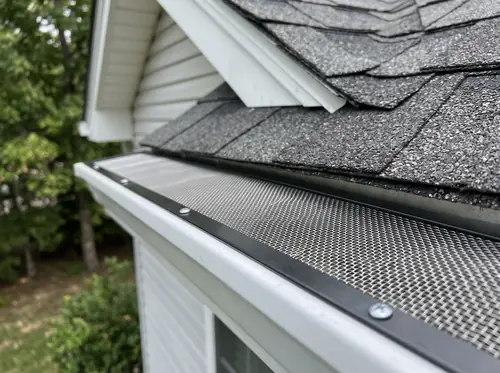
On this page
The options
| Type | How it works | Needles | Oak leaves | Summer downpours | Looks |
|---|---|---|---|---|---|
| Plastic or metal screen | Coarse grid clipped in | Poor | Fair | Good | Low profile |
| Perforated aluminum | Sheet with holes | Fair | Good | Fair | Low profile |
| Reverse-curve hood | Solid cover, water follows curve | Fair | Good | Can overshoot | Visible |
| Foam insert | Block fills trough | Poor | Fair | Fair | Hidden |
| Brush insert | Bristles fill trough | Poor | Fair | Good | Hidden |
| Micro-mesh (for comparison) | Fine stainless mesh | Good | Good | Good | Low profile |
Why needles beat screens
Loblolly pine, the most common pine in the eastern Piedmont, drops needles 6 to 9 inches long. They are thin enough to slide through the openings in a coarse screen and long enough to lodge across it, so they end up half in and half out of the gutter. Sweetgum balls sit in the openings. Under pines, a screen often turns cleaning into a harder job.
Where hoods work and fail
Reverse-curve hoods shed oak and poplar leaves well. Their weakness is volume: when a summer storm drops an inch in an hour on a steep roof, water can outrun the curve and shoot past the gutter, especially where a valley concentrates flow. Durham's summer months each bring about 5 inches of rain, so it is worth asking how the hood handles valleys on your roof.
Fastening
Clip-in screens and inserts come out. Under trees that drop limbs in thunderstorms, and in the occasional ice storm like December 2002, anything not screwed down tends to end up in the yard.
When a screen or hood is enough
- Light leaf loads, no pines nearby
- Single-story houses where cleaning is easy
- A tight budget, with the plan to check them more often
When to go to micro-mesh
- Pines over the roof
- Old willow oaks or water oaks nearby
- Two-story houses where cleaning is hard
- You want to clean as little as possible
See micro-mesh gutter guards and are gutter guards worth it?.
Cost factors
Screens and inserts cost the least. Hoods and micro-mesh cost more per foot, installed. The gutter's condition, its height and the number of corners also matter. Ask for the product name and fastening method in writing.
How a reverse-curve hood works
Water running off the roof follows the rounded front edge of the hood by surface tension and drops through a narrow slot into the gutter. Leaves and needles, which do not cling the same way, slide off the front. It works well in steady rain. In a cloudburst, the volume can outrun the curve, especially on steep roofs and at valleys.
Screens that last longer
If you choose a screen, look for:
- Metal, not plastic, which sags and cracks in summer heat.
- Screwed fastening, not clips.
- A profile that sits flat, so needles do not wedge between screen and gutter.
- Easy removal so the gutter can be flushed.
A quick decision table
| Your situation | Best fit |
|---|---|
| Pines overhead | Micro-mesh |
| Big leaves only, moderate pitch | Hood or perforated cover |
| Light leaves, one story, budget | Metal screen |
| Steep roof with valleys | Micro-mesh |
Neighborhood fit
| Area | Better choice |
|---|---|
| Pine-heavy Woodcroft, Parkwood, Treyburn | Micro-mesh over screens |
| Oak-lined Trinity Park, Watts-Hillandale | Micro-mesh or a well-fitted hood |
| Lightly treed Southpoint, Brier Creek | Screens or covers can be enough |