
On this page
The short answer
Once a year in late fall for houses with few trees. Twice a year, in early December and again in late spring, for houses under pines or big oaks. More often, or guards, under pines and oaks together.
A Durham schedule
| Month | What is coming down | Action |
|---|---|---|
| March to May | Pine and oak pollen, catkins, maple seeds | Late-spring flush |
| June to August | Storm-torn leaves and twigs | Check after big storms |
| September to October | Early leaves, first needles | Wait if you can |
| November to early December | Loblolly needles, oak and poplar leaves | Main cleaning |
| January to February | Sweetgum balls, late leaves, ice-broken twigs | Check outlets |
North Carolina pines normally shed older needles in the fall, and loblolly needles drop in their third season.
By house
| House | How often |
|---|---|
| Few trees nearby | Once a year |
| Under oaks or maples | Once, with a spring check |
| Under pines | Twice a year |
| Under pines and oaks | Twice or more, or guards |
| With micro-mesh guards | Brush once or twice a year |
Signs it is overdue
- Water sheets over the front edge in rain
- Seedlings or grass growing in the gutter
- A run sagging in the middle
- Stains on the fascia or siding below
- Puddles beside the foundation
- A downspout quiet in heavy rain
Why it matters in summer
Durham's heaviest rain comes in July, August and September, about 5 inches a month on average. A gutter left half full from the fall and spring overflows in the first summer storm, right when the most water is coming off the roof.
Doing it yourself safely
- Set the ladder on firm, level ground; never lean it on the gutter.
- Have someone hold it.
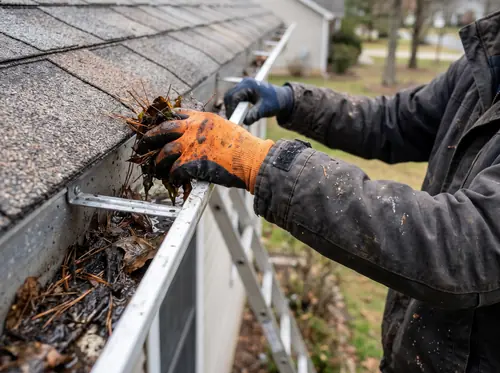
- Use gloves and a scoop; bag the debris.
- Flush downspouts with a hose.
- Stay off wet roofs and stay away from power lines.
- Leave two-story houses and steep lots to someone with the equipment.
Checklist after cleaning
- Run water through each gutter; it should flow to the outlet
- Look for drips at corners
- Check hangers for looseness
- Check fascia for soft spots
- Make sure extensions are in place
See gutter cleaning and gutter guards.
What a professional cleaning should cost you in time
A good cleaning on a typical house includes hand-clearing every run, flushing every downspout and a quick check of hangers, corners and fascia. If a crew is in and out in a few minutes with a leaf blower, ask what was flushed and checked.
Common mistakes
- Cleaning in October and again in December because the oaks were not finished.
- Blowing debris onto the roof or beds, where it washes back into the gutter or smothers plants.
- Skipping downspouts. A clean gutter over a blocked downspout still overflows.
- Leaning the ladder on the gutter.
Local timing note
Late fall in Durham brings loblolly needles and oak leaves together. Spring brings pollen, which settles in the trough and holds water. Summer, the wettest season at Raleigh-Durham airport, is when a half-full gutter shows its faults. Timing your cleaning around those three seasons gets the most from each visit.
Neighborhood timing
| Area | Main debris | Suggested schedule |
|---|---|---|
| Trinity Park, Watts-Hillandale, Forest Hills | Willow and water oak leaves | Early December; spring flush |
| Woodcroft, Parkwood, Treyburn | Loblolly needles | Late November or December, and late spring |
| Southpoint, Morrisville, Brier Creek | Light, from young trees and buffers | Once a year, late fall |
| Bahama, Rougemont, Efland | Pines and hardwoods | Twice a year, or guards |
| Downtown and East Durham | Street trees, litter on flat roofs | Late fall; check scuppers |
What it costs to skip a cleaning
Skipping one cleaning rarely ruins a gutter. Skipping several does: debris holds water, the gutter gets heavy and sags, hangers loosen, overflow soaks the fascia, and the downspout that should carry water away sits blocked. Each of those is a repair. A yearly cleaning is cheaper than any of them.