
On this page
- The short answer
- Side by side
- Why Durham's rain changes the answer
- What decides the size
- Houses that often need 6-inch
- Houses that usually do fine with 5-inch
- Fix overflow in this order
- Checklist
- How to watch your gutters in a storm
- Common mistakes
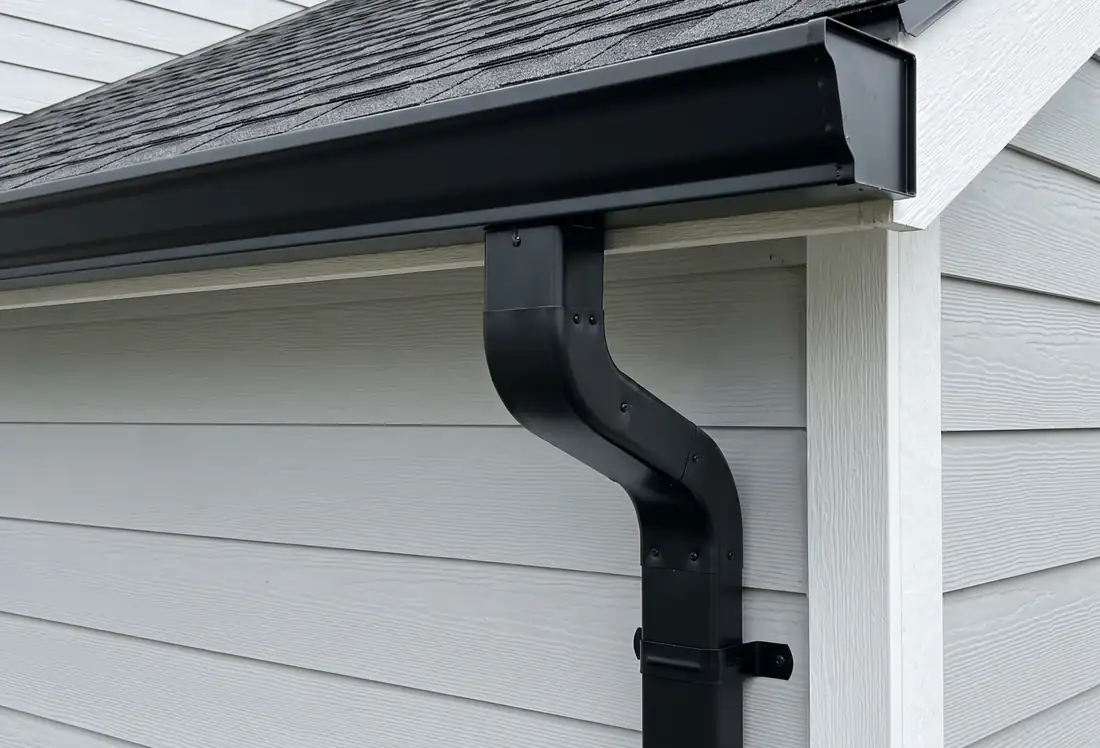
- Downspout size matters as much
- Durham house examples
- Questions to ask a contractor
The short answer
Most single-story Durham houses with modest roof planes do fine with 5-inch K-style gutters and 2x3 downspouts. Steep two-story roofs, long eaves and roofs with valleys pouring into one spot are better with 6-inch gutters and 3x4 downspouts on those runs. Often the cheapest fix for overflow is a bigger or extra downspout.
Side by side
| 5-inch | 6-inch | |
|---|---|---|
| Typical downspout | 2x3 inch | 3x4 inch |
| Capacity | Standard | Considerably more |
| Best for | Single-story, low to medium pitch | Steep, two-story, long runs, valleys |
| Weight when full | Lighter | Heavier |
| Clogging | 2x3 downspouts clog more | 3x4 downspouts pass debris better |
| Looks | Suits most houses | In proportion on two-story houses |
| Price | Base | A few dollars a foot more (Angi) |
Why Durham's rain changes the answer
What matters for gutter size is not how much rain falls in a year but how hard it falls in an hour. Raleigh-Durham airport's daily normals put about 5 inches in each of July, August and September, and much of it comes in thunderstorms that drop an inch or more in a short burst. Tropical systems add more: Chantal in July 2025 brought flooding rain to the central Piedmont. A gutter sized for gentle rain overflows in those bursts.
What decides the size
| Factor | Pushes toward 5-inch | Pushes toward 6-inch |
|---|---|---|
| Roof area per run | Small | Large |
| Pitch | Low (4/12 to 6/12) | Steep (8/12 and up) |
| Valleys | None over the run | Valley pouring into the run |
| Run length | Short, downspout nearby | Long, downspout far away |
| Trees | Few | Pines; bigger downspouts clog less |
| Fascia | Narrow | Deep enough to look right |
Houses that often need 6-inch
- Two-story houses near Southpoint, in Brier Creek, Morrisville and Cary with big, steep roofs
- Houses with porch roofs or valleys aimed at the front corners, common in Woodcroft and Treyburn
- Large period houses in Hope Valley and Forest Hills
Houses that usually do fine with 5-inch
- Mill houses in Old West Durham and East Durham
- Brick ranches in Parkwood and Northgate Park
- Single-story bungalows, with half-round sized up where needed
Fix overflow in this order
- Clean the gutter and outlet.
- Check the pitch; re-hang if it holds water.
- Swap the 2x3 downspout for a 3x4.
- Add a downspout at the far end of a long run.
- Add a splash guard where a valley overshoots.
- Go to 6-inch on that run.
Checklist
- Watch each run in a hard rain and note where it overflows
- Note which runs sit under valleys
- Count downspouts and their size
- Ask for the quote to say which runs are 5-inch and which 6-inch, and why
How to watch your gutters in a storm
The best sizing test is free. During the next hard summer rain:
- Stand where you can see each run, under cover.
- Watch the inside corners first, especially under valleys.
- Look for water sheeting over the front edge along a stretch, not just a drip.
- Check the downspout: is it full and gushing, or quiet while the gutter overflows?
- Afterward, look for washed-out mulch lines under the eaves.
A quiet downspout under an overflowing gutter means a clog. A gushing downspout under an overflowing gutter means the system is undersized for that run.
Common mistakes
- Upsizing the gutter but keeping 2x3 downspouts. The downspout is often the bottleneck.
- Putting 6-inch everywhere when only one or two runs need it.
- Ignoring valleys. A splash guard at an inside corner can solve overshoot without changing size.
Downspout size matters as much
| Downspout | Typical use | Clogging under pines |
|---|---|---|
| 2x3 inch | 5-inch gutters, small roofs | Clogs more easily |
| 3x4 inch | 6-inch gutters, big roofs, valleys | Passes needles and sweetgum balls better |
| 3-inch round | 5-inch half-round | Moderate |
| 4-inch round | 6-inch half-round | Better |
Durham house examples
- Mill house in East Durham: short eaves, small roof. 5-inch with 2x3 downspouts, placed well, is plenty.
- Bungalow in Duke Park: moderate roof, porch. 6-inch half-round or 5-inch K-style with 3x4 downspouts.
- 1980s Colonial in Woodcroft: long front run, porch roof. 5-inch often fine with a second downspout; 6-inch at the porch corner if it overflows.
- New two-story near Southpoint: steep roof, two valleys. 6-inch on the valley runs, 3x4 downspouts.
- Tudor in Hope Valley: very steep, many valleys. 6-inch and splash guards at inside corners.
Questions to ask a contractor
- Which runs need 6-inch, and why those?
- Would a 3x4 downspout or an extra downspout solve it instead?
- How will the 5-inch and 6-inch runs meet at corners?
- Will the fascia take the extra weight?